
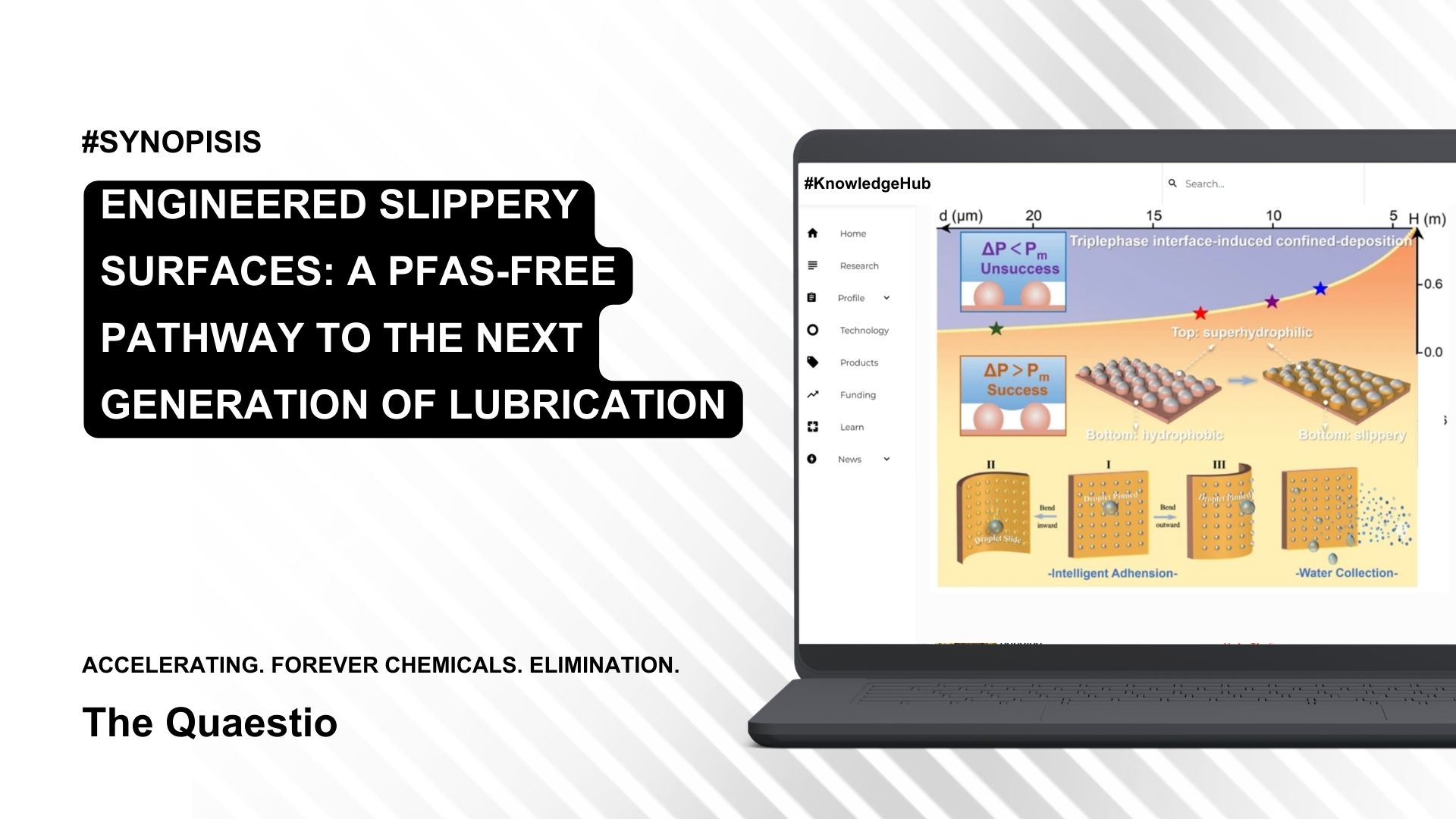
Engineered Slippery Surfaces: A PFAS-Free Pathway to the Next Generation of Lubrication
LATEST RESEARCH

LATEST HUB NEWS

Poly-U™ is a polyurethane-based thread seal tape designed to provide reliable sealing performance without the use of PTFE or PFAS. The fluoropolymer-free formulation aims to meet growing regulatory and environmental requirements while maintaining durability and sealing strength for industrial applications.
5 months ago Product Launch

Nonwovenn has expanded its PFAS-free activated carbon filter media used in ostomy pouches. The material provides odor and gas adsorption with low-pressure drop while supporting compliance with evolving PFAS regulations in medical device markets.
5 months ago Product Launch
University of Bath researchers have developed a carbon-based photocatalyst that uses sunlight to degrade PFAS contaminants. Created with partners including University of São Paulo, University of Edinburgh, and Swansea University, the catalyst combines carbon nitride with a microporous polymer to capture PFAS and break them down into carbon dioxide and fluoride.
5 months ago Technology Development

Flinders University researchers have developed a nano-sized molecular cage adsorbent capable of capturing difficult-to-remove short-chain PFAS from water. Embedded into mesoporous silica, the material removed up to 98% of PFAS in laboratory tests and demonstrated reusability across multiple cycles, highlighting potential for advanced water filtration systems.
5 months ago Technology Development
LATEST HUB PATENTS

The invention belongs to the technical field of preparation of biochar-based materials, and discloses a preparation method of a modified biochar-based material and application thereof in improvement of salinized soil, wherein the preparation method of the modified biochar-based material comprises the fo
1 year ago
Environment

The invention discloses a composite active carbon filtering device for efficiently removing perfluorinated compounds, which relates to the technical field of active carbon filtering, and comprises a filter element shell piece, wherein a guide piece is arranged on the filter element sh
1 year ago
Water Treatment

The invention discloses a Janus-MOF composite material and a preparation method and application thereof, wherein the Janus-MOF composite material is formed by heterogeneous integration of an adsorption module and a signal module through a lattice orientation growth metho
1 year ago
Water Treatment

The invention discloses a microbacterium strain (Microbacterium sp.) TF-9 and application of the microbacterium strain (Microbacterium sp.) TF-9 in biological defluorination. The microbacterium strain (Microbacterium sp.) TF-9 is preserved in the General Microbiological Center of China Committee for Culture Collection of Microorganisms on
1 year ago
Environment
LATEST HUB PAPER

Technologies based on anion exchange membranes (AEMs), including fuel cells (AEMFCs) and water electrolysis (AEMWE), offer strong potential due to their use of non-precious metal catalysts and fluorine-free polyelectrolytes. However, CO2 in cathode air causes severe voltage loss (“carbonation”), restricting large-scale AEMFC deployment. Using multiple operando techniques, this study elucidates the carbonation-induced degradation mechanism. Combined operando electrochemical impedance spectroscopy (EIS) and distribution of relaxation times (DRT) analysis reveal that carbonation elevates mass transport polarization resistance by over two orders of magnitude, dominating voltage loss. Operando EIS and anode CO2 outlet monitoring show this effect arises not from reduced membrane conductivity, but from CO32? enrichment in the anode catalyst layer ionomer via the CO2–CO32- equilibrium. AEMFC operation follows mass conservation: CO32? and OH? migrate simultaneously to the anode and participate in the hydrogen oxidation reaction in ratios determined at the cathode. In-situ surface-enhanced Raman spectroscopy (SERS) and electrochemical quartz crystal microbalance (EQCM) reveal carbonation forms a thickened electric double layer (EDL) at the electrode/polyelectrolyte interface, weakening interfacial electric fields and hindering CO32? transport. Modulating anode ionomer ion exchange capacity (IEC) reduces both mass transport resistance and voltage loss, experimentally validating the mechanism and advancing understanding of EDL dynamics in AEMFCs.
7 months ago Material

Given its inherent porous structure and particular chemical makeup, wood is highly vulnerable to the combined effects of moisture and UV radiation when exposed to the outdoors, which can lead to a range of performance-related issues. This deterioration phenomenon is particularly prominent in wood structure buildings in areas with high ultraviolet radiation, which seriously affects the service life and aesthetics of wood. In order to solve this problem, this paper proposes a new protective coating system based on modified nano-SiO2. Through a simple one-step blending process, the modified nano-SiO2, palm wax, polydimethylsiloxane-trimethyl terminated (PDMS-Ts), organic ultraviolet absorber (UV-329), light stabilizer (HALS-770), ?-glycidoxypropyltrimethoxysilane (KH560) and isopropyl titanate (TTIP) were compounded in dichloromethane solvent, and then the dispersion was evenly covered on the wood surface by spraying method. This coating not only endows wood with excellent superhydrophobic properties (WCA = 161.1?±?1.1°, SA ? 1?±?0.5°), but also significantly enhances its ultraviolet shielding ability (color difference ?E* = 2.04), effectively inhibiting the photodegradation of ultraviolet light on wood. Moreover, the treated wood displays outstanding resistance to staining, self-decontaminating capabilities, and improved durability. Following rigorous mechanical wear testing (e.g., sandpaper abrasion, fingernail scratches, and impact from gravel) as well as chemical stability evaluation, the wood surface retained consistent superhydrophobic characteristics. The anti-weathering fluorine-free superhydrophobic coating developed in this study provides an innovative and efficient new idea for the protection of the external walls of wooden buildings in areas with high ultraviolet radiation. It is expected to significantly prolong the service life of wood and maintain its aesthetics, which opens up new possibilities for the application of wood in the field of outdoor architecture.
7 months ago

The practical deployment of aqueous zinc-ion batteries (AZIBs) is often hindered by cathode swelling, structural degradation, and sluggish ion transport arising from unstable binder/conductive networks. Here, we report a swelling-resistant dielectric-conductive crosslinked network by integrating Zr4+-modified nanocellulose (Zr-CNF) with carbon nanotubes (CNTs) to construct freestanding paper cathodes. The amorphous Zr-O coating on Zr-CNF shields cellulose hydroxyl groups, suppresses water-induced swelling, and crosslinks adjacent fibers to preserve morphology and mechanical integrity. Meanwhile, the intrinsic dielectric property of Zr-CNF regulates interfacial polarization, eliminates space charges, and accelerates transport. Mechanistic studies reveal that Zr-CNF conductive network lowers the Li+ diffusion activation energy to 17.5 kJ mol-1, while suppresses Mn3+ disproportionation and structural collapse. Consequently, LiMn2O4 cathodes based on the Zr-CCNT framework deliver a high specific capacity of 108 mAh g-1 at 5 C and retain 60.2% of their capacity after 250 cycles at a mass loading of 6.44 mg cm-2. Furthermore, the universality of this design is demonstrated in Zn//AC capacitors, which show only 9.5% capacity loss after 10000 cycles. This work establishes a generalizable strategy for anti-swelling, multifunctional nanocellulose frameworks that couple structural resilience with accelerated ion/electron transport, providing a sustainable pathway toward high-performance aqueous batteries.
7 months ago Material

In this research work, a novel sample preparation FPSE-UPLC-MS/MS method was developed for the selective determination of PFAS in sunflower oil samples. The reliable determination of PFAS in edible oils is particularly challenging due to their occurrence at trace levels, their interaction with lipid-rich matrices, and the strong matrix effects that can compromise sensitivity and accuracy. The main steps that affect the sample preparation procedure were optimized and the method was validated. Good selectivity, accuracy, precision, linearity, and sensitivity were demonstrated. As revealed by BAGI and ComplexMoGAPI evaluation, the herein developed method exhibited good practicality in terms of applicability and reduced environmental impact. These benefits can be attributed to the decreased consumption of organic solvent during the FPSE procedure, the possibility for parallel sample handling, the reduced sample consumption, and the simple and efficient synthetic procedure for the preparation of the sol-gel CW 20 M coated membranes. Finally, the FPSE-UPLC-MS/MS method was utilized for the analysis of various sunflower oil samples. Most samples showed PFAS concentrations below the detection limit, indicating insignificant contamination. However, trace amounts were detected in several samples including PFOA in twelve, PFNA in six, and PFOS in three samples with one sunflower oil sample exhibiting the highest levels (0.008 µg kg-1 PFOA and 0.005 µg kg-1 PFOS).
7 months ago Food
UPDATED PROFILES (DEVELOPERS)
| Name | Industry Tag | Product Tag | ||
|---|---|---|---|---|
 |
Dimpora | Textile |
dimpora® BIO |
|
 |
Green Theme Technologies | Textile |
EMPEL® |
NEW PROFILES (DEVELOPERS)
| Name | Industry Tag | Product Tag | ||
|---|---|---|---|---|
 |
Flinders University | |||
 |
eVent Fabrics | Textile |
||
 |
Temple University | |||
 |
iFabric Corp | Textile |
||
 |
Zeus | Material |
My Followed Profiles
| Name | Type | Country | |
|---|---|---|---|
| You have to login to see followed profiles... | |||
NEW PRODUCT PROFILES
| Name | Product Name | Sub Type | |
|---|---|---|---|

|
SAATI | SAATIenergy PEEK and PPS Mesh | Membrane |

|
GreenPan | Thermolon™ 9G | Coating |

|
Envalior | Pocan® BFN4232ZHR S1 | Coating |

|
Tenneco | GLYCODUR® NEO | MATERIAL |

|
Rely Innovations | Rely FX P2.5SFFF | Foam |